Atmospheric Rivers and the Wettest Year on Record: A Growing Climate Challenge for the West Coast
As atmospheric rivers bring heavy rains and flooding to the Pacific Northwest, scientists warn that a warming climate is intensifying these events, raising concerns about future risks and the need for preparedness.

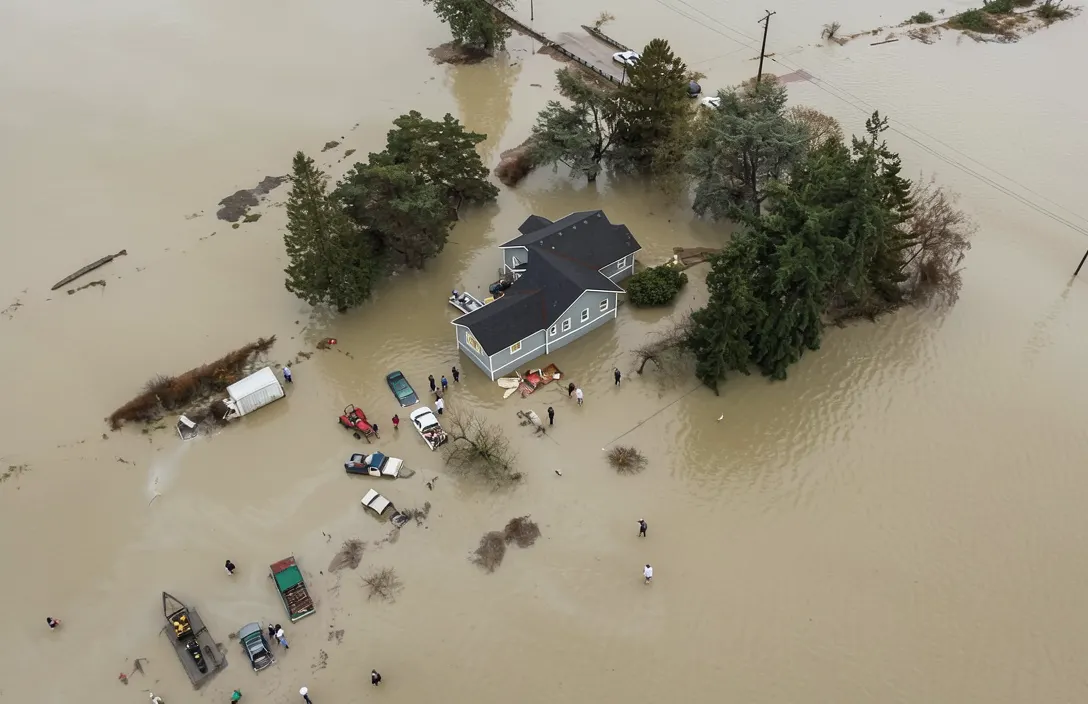

Heavy rains and flooding have impacted the Pacific Northwest, with atmospheric rivers bringing significant precipitation to the region. As of December 6, 2023, floodwaters surrounded homes in Stanwood, Washington, highlighting the immediate effects of these weather events (Source ID: 1). These atmospheric rivers, which are narrow bands of water vapor pushed by wind, can be up to 2,000 miles long and 600 miles wide, according to F. Martin Ralph, director of the Center for Western Weather and Water Extremes at UC San Diego’s Scripps Institution of Oceanography (Source ID: 1). [1]
Atmospheric rivers are a natural climate pattern but have become more impactful in recent years. According to data from the Federal Emergency Management Agency, 90% or more of all flood damage in the Western U.S. is from atmospheric rivers (Source ID: 1). This year’s atmospheric river season, which typically runs from October to March, has started with above-average intensity, as noted by Josh Weiss, a meteorologist with the National Oceanic and Atmospheric Administration’s Weather Prediction Center (Source ID: 1). [1]
The combination of atmospheric rivers with El Niño’s warm ocean waters and annual high tides, known as King tides, increases the risk of flooding along the West Coast. El Niño contributes to rising sea levels and fuels storm systems, compounding the impacts of heavy rainfall (Source ID: 1). Meteorologists warn that the region is experiencing compounding impacts from multiple atmospheric rivers, leading to flash flooding, urban flooding, and even landslides (Source ID: 1). [1]
A warming climate is contributing to more intense and frequent precipitation events. According to the National Centers for Environmental Information (NCEI), a warmer atmosphere can hold more water vapor, leading to increased precipitation. A 1°F rise in temperature can increase atmospheric water vapor by as much as 4%, contributing to more extreme rainfall events (Source ID: 2). This trend has already been observed in the contiguous United States, with 2019 being the second-wettest year on record (Source ID: 2). [2]
Advertisement
The increase in extreme precipitation events is not limited to the West Coast. Big rain events have become more frequent and intense across the United States, with the most significant events contributing more to annual rainfall than in previous decades (Source ID: 2). These changes are reflected in NCEI’s Climate Extremes Index, which shows a dramatic rise in one-day rainfall totals since the 1990s (Source ID: 2). [2]
While the relationship between El Niño and atmospheric rivers is not as straightforward as once thought, a warming world is clearly affecting the frequency and intensity of these events. Climate scientists note that a warming atmosphere means more water vapor, leading to more precipitation. However, there is not enough data to directly link atmospheric rivers to human-caused global warming (Source ID: 1). [1]
The implications of these changes are significant. As atmospheric rivers become more intense, coastal and inland areas along the West Coast face greater risks of flooding. Additionally, the impact of these events on infrastructure, agriculture, and communities is growing, raising concerns about future preparedness and adaptation (Source ID: 1). Scientists and meteorologists emphasize the need for continued monitoring and research to understand the long-term effects of these weather patterns (Source ID: 1). [1]
What remains unclear is the full extent of how climate change will influence atmospheric rivers in the coming decades. While there is evidence that a warming climate is increasing the frequency and intensity of extreme precipitation events, the specific ways in which these changes will manifest in different regions are still under study (Source ID: 2). Scientists stress the importance of ongoing research and improved forecasting to help communities prepare for the growing risks associated with atmospheric rivers (Source ID: 2). [2]
Advertisement
Looking ahead, adaptation efforts are gaining momentum. As the climate continues to change, public and private sectors are developing new tools and strategies to manage the impacts of more extreme rainfall and flooding. However, the challenges posed by atmospheric rivers and other climate-related events will require sustained attention and investment in preparedness and resilience (Source ID: 2). [2]
The role of atmospheric rivers in shaping the climate of the Pacific Northwest and beyond remains a key area of focus for scientists. With the region already experiencing the compounding effects of multiple atmospheric rivers, the need for better understanding and forecasting of these events is more urgent than ever (Source ID: 1). [1]
Heavy rains and flooding have impacted the Pacific Northwest, with atmospheric rivers bringing significant precipitation to the region. As of December 6, 2023, floodwaters surrounded homes in Stanwood, Washington, highlighting the immediate effects of these weather events (Source ID: 1). These atmospheric rivers, which are narrow bands of water vapor pushed by wind, can be up to 2,000 miles long and 600 miles wide, according to F. Martin Ralph, director of the Center for Western Weather and Water Extremes at UC San Diego’s Scripps Institution of Oceanography (Source ID: 1). [1]
Atmospheric rivers are a natural climate pattern but have become more impactful in recent years. According to data from the Federal Emergency Management Agency, 90% or more of all flood damage in the Western U.S. is from atmospheric rivers (Source ID: 1). This year’s atmospheric river season, which typically runs from October to March, has started with above-average intensity, as noted by Josh Weiss, a meteorologist with the National Oceanic and Atmospheric Administration’s Weather Prediction Center (Source ID: 1). [1]
Advertisement
The combination of atmospheric rivers with El Niño’s warm ocean waters and annual high tides, known as King tides, increases the risk of flooding along the West Coast. El Niño contributes to rising sea levels and fuels storm systems, compounding the impacts of heavy rainfall (Source ID: 1). Meteorologists warn that the region is experiencing compounding impacts from multiple atmospheric rivers, leading to flash flooding, urban flooding, and even landslides (Source ID: 1). [1]
A warming climate is contributing to more intense and frequent precipitation events. According to the National Centers for Environmental Information (NCEI), a warmer atmosphere can hold more water vapor, leading to increased precipitation. A 1°F rise in temperature can increase atmospheric water vapor by as much as 4%, contributing to more extreme rainfall events (Source ID: 2). This trend has already been observed in the contiguous United States, with 2019 being the second-wettest year on record (Source ID: 2). [2]
The increase in extreme precipitation events is not limited to the West Coast. Big rain events have become more frequent and intense across the United States, with the most significant events contributing more to annual rainfall than in previous decades (Source ID: 2). These changes are reflected in NCEI’s Climate Extremes Index, which shows a dramatic rise in one-day rainfall totals since the 1990s (Source ID: 2). [2]
While the relationship between El Niño and atmospheric rivers is not as straightforward as once thought, a warming world is clearly affecting the frequency and intensity of these events. Climate scientists note that a warming atmosphere means more water vapor, leading to more precipitation. However, there is not enough data to directly link atmospheric rivers to human-caused global warming (Source ID: 1). [1]
Advertisement
The implications of these changes are significant. As atmospheric rivers become more intense, coastal and inland areas along the West Coast face greater risks of flooding. Additionally, the impact of these events on infrastructure, agriculture, and communities is growing, raising concerns about future preparedness and adaptation (Source ID: 1). Scientists and meteorologists emphasize the need for continued monitoring and research to understand the long-term effects of these weather patterns (Source ID: 1). [1]
What remains unclear is the full extent of how climate change will influence atmospheric rivers in the coming decades. While there is evidence that a warming climate is increasing the frequency and intensity of extreme precipitation events, the specific ways in which these changes will manifest in different regions are still under study (Source ID: 2). Scientists stress the importance of ongoing research and improved forecasting to help communities prepare for the growing risks associated with atmospheric rivers (Source ID: 2). [2]
Looking ahead, adaptation efforts are gaining momentum. As the climate continues to change, public and private sectors are developing new tools and strategies to manage the impacts of more extreme rainfall and flooding. However, the challenges posed by atmospheric rivers and other climate-related events will require sustained attention and investment in preparedness and resilience (Source ID: 2). [2]
The role of atmospheric rivers in shaping the climate of the Pacific Northwest and beyond remains a key area of focus for scientists. With the region already experiencing the compounding effects of multiple atmospheric rivers, the need for better understanding and forecasting of these events is more urgent than ever (Source ID: 1). [1]
Heavy rains and flooding have impacted the Pacific Northwest, with atmospheric rivers bringing significant precipitation to the region. As of December 6, 2023, floodwaters surrounded homes in Stanwood, Washington, highlighting the immediate effects of these weather events (Source ID: 1). These atmospheric rivers, which are narrow bands of water vapor pushed by wind, can be up to 2,000 miles long and 600 miles wide, according to F. Martin Ralph, director of the Center for Western Weather and Water Extremes at UC San Diego’s Scripps Institution of Oceanography (Source ID: 1). [1]
Atmospheric rivers are a natural climate pattern but have become more impactful in recent years. According to data from the Federal Emergency Management Agency, 90% or more of all flood damage in the Western U.S. is from atmospheric rivers (Source ID: 1). This year’s atmospheric river season, which typically runs from October to March, has started with above-average intensity, as noted by Josh Weiss, a meteorologist with the National Oceanic and Atmospheric Administration’s Weather Prediction Center (Source ID: 1). [1]
The combination of atmospheric rivers with El Niño’s warm ocean waters and annual high tides, known as King tides, increases the risk of flooding along the West Coast. El Niño contributes to rising sea levels and fuels storm systems, compounding the impacts of heavy rainfall (Source ID: 1). Meteorologists warn that the region is experiencing compounding impacts from multiple atmospheric rivers, leading to flash flooding, urban flooding, and even landslides (Source ID: 1). [1]
A warming climate is contributing to more intense and frequent precipitation events. According to the National Centers for Environmental Information (NCEI), a warmer atmosphere can hold more water vapor, leading to increased precipitation. A 1°F rise in temperature can increase atmospheric water vapor by as much as 4%, contributing to more extreme rainfall events (Source ID: 2). This trend has already been observed in the contiguous United States, with 2019 being the second-wettest year on record (Source ID: 2). [2]
The increase in extreme precipitation events is not limited to the West Coast. Big rain events have become more frequent and intense across the United States, with the most significant events contributing more to annual rainfall than in previous decades (Source ID: 2). These changes are reflected in NCEI’s Climate Extremes Index, which shows a dramatic rise in one-day rainfall totals since the 1990s (Source ID: 2). [2]
While the relationship between El Niño and atmospheric rivers is not as straightforward as once thought, a warming world is clearly affecting the frequency and intensity of these events. Climate scientists note that a warming atmosphere means more water vapor, leading to more precipitation. However, while a warming world is acknowledged to influence these events through increased water vapor in the atmosphere, the direct link between atmospheric rivers and human-caused global warming is not explicitly discussed (Source ID: 1). [1]
The implications of these changes are significant. As atmospheric rivers become more intense, coastal and inland areas along the West Coast face greater risks of flooding. Additionally, the impact of these events on infrastructure, agriculture, and communities is growing, raising concerns about future preparedness and adaptation (Source ID: 1). Scientists and meteorologists emphasize the need for continued monitoring and research to understand the long-term effects of these weather patterns (Source ID: 1). [1]
What remains unclear is the full extent of how climate change will influence atmospheric rivers in the coming decades. While there is evidence that a warming climate is increasing the frequency and intensity of extreme precipitation events, the specific ways in which these changes will manifest in different regions are still under study (Source ID: 2). Scientists stress the importance of ongoing research and improved forecasting to help communities prepare for the growing risks associated with atmospheric rivers (Source ID: 2). [2]
Looking ahead, adaptation efforts are gaining momentum. As the climate continues to change, public and private sectors are developing new tools and strategies to manage the impacts of more extreme rainfall and flooding. However, the challenges posed by atmospheric rivers and other climate-related events will require sustained attention and investment in preparedness and resilience (Source ID: 2). [2]
The role of atmospheric rivers in shaping the climate of the Pacific Northwest and beyond remains a key area of focus for scientists. With the region already experiencing the compounding effects of multiple atmospheric rivers, the need for better understanding and forecasting of these events is more urgent than ever (Source ID: 1). [1]
In the wake of these events, questions remain about the adequacy of current infrastructure and emergency response systems. How will local governments and emergency management agencies adapt to the increasing frequency of such events? What role will federal agencies like the Federal Emergency Management Agency (FEMA) play in supporting local efforts? These questions underscore the need for a more comprehensive and integrated approach to disaster preparedness and climate adaptation (Source ID: 1). [1]
Another key question is how communities will manage the long-term impacts of these events on infrastructure and public health. For example, how will repeated flooding affect transportation networks, water treatment facilities, and power grids? What measures can be taken to protect vulnerable populations, such as the elderly and low-income residents, who may be disproportionately affected by extreme weather events? These issues require careful planning and collaboration between government agencies, private sector entities, and local communities (Source ID: 2). [2]
There is also a need to address the broader implications of climate change on the region’s ecosystems. How will the increased frequency of atmospheric rivers affect local wildlife, plant species, and natural habitats? What steps can be taken to protect biodiversity and ensure the long-term sustainability of the region’s natural resources? These are complex issues that will require ongoing research and policy development (Source ID: 2). [2]
In the context of these challenges, it is important to recognize the role of science in informing policy and public awareness. How can climate scientists and meteorologists better communicate the risks associated with atmospheric rivers to the public? What steps can be taken to improve public understanding of climate change and its impacts on weather patterns? These questions highlight the importance of science communication and public engagement in building resilience to climate-related events (Source ID: 1). [1]
As the region continues to grapple with the impacts of atmospheric rivers, it is clear that the consequences of these events will only become more severe in the coming decades. What steps can be taken to ensure that communities are better prepared for these events? How can governments and private sector entities work together to develop more resilient infrastructure and emergency response systems? These are critical questions that will need to be addressed in the years ahead (Source ID: 2). [2]
The immediate impact of atmospheric rivers on the Pacific Northwest has been starkly evident in recent weeks. As of December 6, 2023, floodwaters surrounded homes in Stanwood, Washington, highlighting the immediate effects of these weather events (Source ID: 1). These atmospheric rivers, which are narrow bands of water vapor pushed by wind, can be up to 2,000 miles long and 600 miles wide, according to F. Martin Ralph, director of the Center for Western Weather and Water Extremes at UC San Diego’s Scripps Institution of Oceanography (Source ID: 1). [1]
Atmospheric rivers are a natural climate pattern but have become more impactful in recent years. According to data from the Federal Emergency Management Agency, 90% or more of all flood damage in the Western U.S. is from atmospheric rivers (Source ID: 1). This year’s atmospheric river season, which typically runs from October to March, has started with above-average intensity, as noted by Josh Weiss, a meteorologist with the National Oceanic and Atmospheric Administration’s Weather Prediction Center (Source ID: 1). [1]
The combination of atmospheric rivers with El Niño’s warm ocean waters and annual high tides, known as King tides, increases the risk of flooding along the West Coast. El Niño contributes to rising sea levels and fuels storm systems, compounding the impacts of heavy rainfall (Source ID: 1). Meteorologists warn that the region is experiencing compounding impacts from multiple atmospheric rivers, leading to flash flooding, urban flooding, and even landslides (Source ID: 1). [1]
A warming climate is contributing to more intense and frequent precipitation events. According to the National Centers for Environmental Information (NCEI), a warmer atmosphere can hold more water vapor, leading to increased precipitation. A 1°F rise in temperature can increase atmospheric water vapor by as much as 4%, contributing to more extreme rainfall events (Source ID: 2). This trend has already been observed in the contiguous United States, with 2019 being the second-wettest year on record (Source ID: 2). [2]
The increase in extreme precipitation events is not limited to the West Coast. Big rain events have become more frequent and intense across the United States, with the most significant events contributing more to annual rainfall than in previous decades (Source ID: 2). These changes are reflected in NCEI’s Climate Extremes Index, which shows a dramatic rise in one-day rainfall totals since the 1990s (Source ID: 2). [2]
While the relationship between El Niño and atmospheric rivers is not as straightforward as once thought, a warming world is clearly affecting the frequency and intensity of these events. Climate scientists note that a warming atmosphere means more water vapor, leading to more precipitation. However, there is not enough data to directly link atmospheric rivers to human-caused global warming (Source ID: 1). [1]
The implications of these changes are significant. As atmospheric rivers become more intense, coastal and inland areas along the West Coast face greater risks of flooding. Additionally, the impact of these events on infrastructure, agriculture, and communities is growing, raising concerns about future preparedness and adaptation (Source ID: 1). Scientists and meteorologists emphasize the need for continued monitoring and research to understand the long-term effects of these weather patterns (Source ID: 1). [1]
What remains unclear is the full extent of how climate change will influence atmospheric rivers in the coming decades. While there is evidence that a warming climate is increasing the frequency and intensity of extreme precipitation events, the specific ways in which these changes will manifest in different regions are still under study (Source ID: 2). Scientists stress the importance of ongoing research and improved forecasting to help communities prepare for the growing risks associated with atmospheric rivers (Source ID: 2). [2]
Looking ahead, adaptation efforts are gaining momentum. As the climate continues to change, public and private sectors are developing new tools and strategies to manage the impacts of more extreme rainfall and flooding. However, the challenges posed by atmospheric rivers and other climate-related events will require sustained attention and investment in preparedness and resilience (Source ID: 2). [2]
The role of atmospheric rivers in shaping the climate of the Pacific Northwest and beyond remains a key area of focus for scientists. With the region already experiencing the compounding effects of multiple atmospheric rivers, the need for better understanding and forecasting of these events is more urgent than ever (Source ID: 1). [1]
In the wake of these events, questions remain about the adequacy of current infrastructure and emergency response systems. How will local governments and emergency management agencies adapt to the increasing frequency of such events? What role will federal agencies like the Federal Emergency Management Agency (FEMA) play in supporting local efforts? These questions underscore the need for a more comprehensive and integrated approach to disaster preparedness and climate adaptation (Source ID: 1). [1]
Another key question is how communities will manage the long-term impacts of these events on infrastructure and public health. For example, how will repeated flooding affect transportation networks, water treatment facilities, and power grids? What measures can be taken to protect vulnerable populations, such as the elderly and low-income residents, who may be disproportionately affected by extreme weather events? These issues require careful planning and collaboration between government agencies, private sector entities, and local communities (Source ID: 2). [2]
There is also a need to address the broader implications of climate change on the region’s ecosystems. How will the increased frequency of atmospheric rivers affect local wildlife, plant species, and natural habitats? What steps can be taken to protect biodiversity and ensure the long-term sustainability of the region’s natural resources? These are complex issues that will require ongoing research and policy development (Source ID: 1). [1]
In the context of these challenges, it is important to recognize the role of science in informing policy and public awareness. How can climate scientists and meteorologists better communicate the risks associated with atmospheric rivers to the public? What steps can be taken to improve public understanding of climate change and its impacts on weather patterns? These questions highlight the importance of science communication and public engagement in building resilience to climate-related events (Source ID: 1). [1]
As the region continues to grapple with the impacts of atmospheric rivers, it is clear that the consequences of these events will only become more severe in the coming decades. What steps can be taken to ensure that communities are better prepared for these events? How can governments and private sector entities work together to develop more resilient infrastructure and emergency response systems? These are critical questions that will need to be addressed in the years ahead (Source ID: 1). [1]
Sources
Prepared with AI assistance from the cited sources.
The Cali Reporter newsletter
The stories worth your time.
California, the country, and what comes next. Join our free newsletter for reporting that keeps you informed.
More in West Coast
- Diwali Celebration at Tigard Mandir Draws Large Crowd
Hundreds of people gathered at the BAPS Shri Swaminarayan Mandir in Tigard, Oregon, for a Diwali celebration featuring a large cultural exhibition and traditional offerings.
- Midterm Elections Shift State Legislative Power to Democrats
The 2022 midterm elections marked a significant shift in state legislative power, with Democrats gaining control in several states and ending long-standing Republican dominance.
- Boise State Secures Pac-12 Championship Host Spot
Boise State's victory over Oregon State on November 14, 2026, solidified their position as the host for the Pac-12 championship game, marking a significant milestone for the team.