Brain-Computer Interface Enables Control of Robotic Arms Without Disrupting Natural Coordination
A new study has demonstrated that a brain-computer interface can allow individuals to control robotic arms simultaneously with their natural hands, with accuracy improving significantly after training.

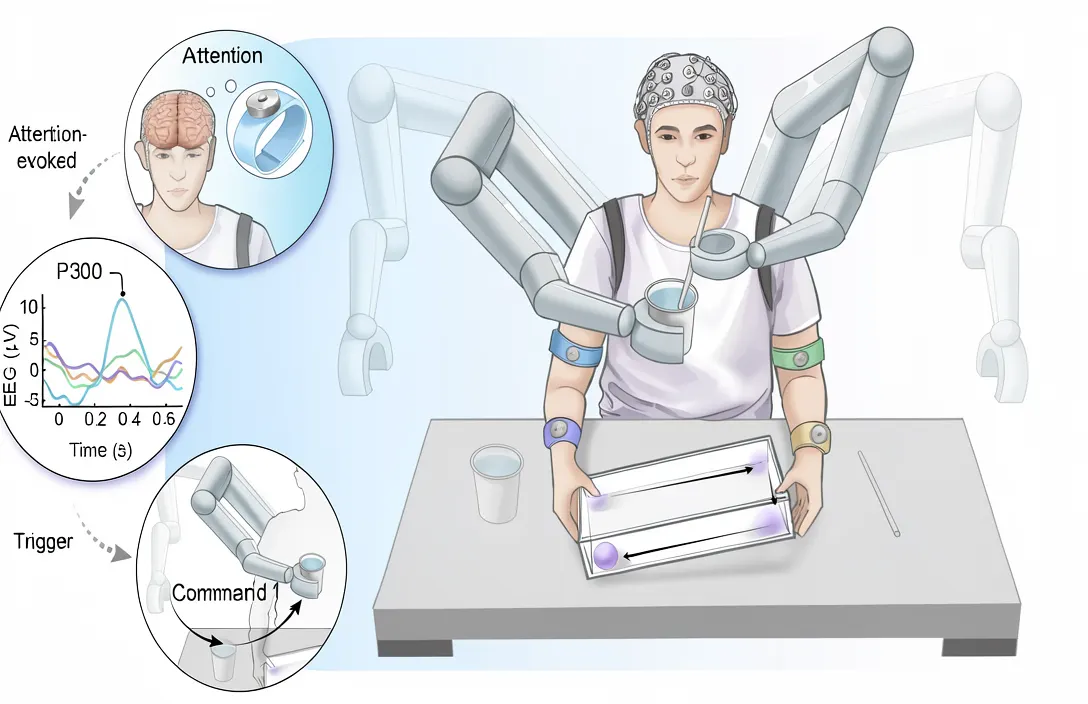
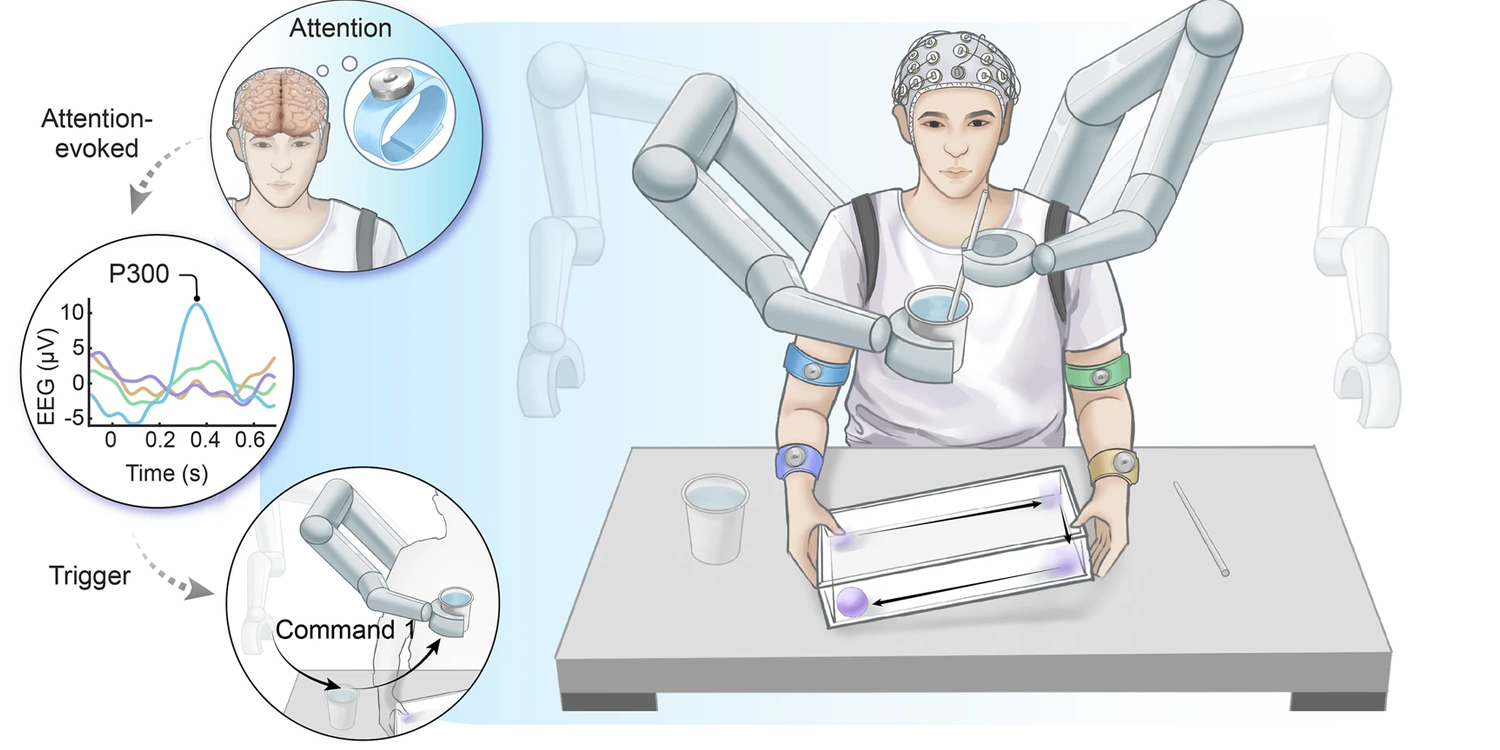
A touch-based brain-computer interface can enable people to command extra robotic arms while simultaneously using their own hands without disrupting their natural physical coordination, according to a new study published in Nature Communications (1). Volunteers triggered a brainwave response by focusing on brief vibrations delivered to different spots on their arms, allowing them to select among four distinct commands while their hands remained occupied with a manual balancing task. After three days of practice, the accuracy gap between moving both hands and sitting still was no longer statistically significant (1). [1]
The brain-computer interface used in the study measured electrical activity in the brain through small sensors resting against the scalp and translated specific signal patterns into commands for external machines. This research has previously focused on restoring lost movement after injury or paralysis. In an earlier experiment, a partially paralyzed man used a shared-control brain interface to coordinate two prosthetic arms and feed himself in under 90 seconds (1). More recently, engineers have sought to apply brain interfaces to movement augmentation, equipping able-bodied people with extra robotic limbs or fingers (1). [1]
To bypass motor brainwaves altogether, researchers built an interface around a sensory brain signal called the P300 response. This response occurs when a person pays attention to an infrequent target stimulus, and the brain produces a positive spike in electrical voltage roughly 200 to 500 milliseconds later. Delivering gentle vibrations to the skin can evoke the same P300 brainwave while leaving both vision and the motor system free (1). [1]
The study involved ten right-handed, able-bodied volunteers who wore an electroencephalography cap lined with 64 scalp sensors and four small tactile vibrators taped symmetrically near the wrist and elbow on both arms. Each vibrator corresponded to one of four commands and pulsed in a randomized order. Participants focused their attention on the pulses at one target vibrator while ignoring the buzzes at the other three sites (1). [1]
Advertisement
A touch-based brain-computer interface can enable people to command extra robotic arms while simultaneously using their own hands without disrupting their natural physical coordination, according to a new study published in Nature Communications (1). The brain-computer interface used in the study measured electrical activity in the brain through small sensors resting against the scalp and translated specific signal patterns into commands for external machines. To bypass motor brainwaves altogether, researchers built an interface around a sensory brain signal called the P300 response. This approach relies on the brain's reaction to brief, infrequent stimuli, which can be delivered through tactile vibrations rather than visual cues, making it more suitable for multitasking. [1]
The study involved ten right-handed, able-bodied volunteers who participated in a three-day training program to use the interface. Each volunteer wore an electroencephalography cap lined with 64 scalp sensors to record brain activity, along with four small tactile vibrators placed on their arms to correspond to four distinct commands. Participants were asked to focus their attention on the vibrations at one target location while ignoring the others, allowing the system to detect the P300 response and issue the appropriate command. The interface was tested under both single-task and dual-task conditions, with participants performing a balancing task while using the robotic arms. [1]
By the third day of training, the accuracy of the interface under dual-task conditions improved significantly, with the accuracy gap between moving both hands and sitting still no longer being statistically significant. The system required an average of roughly two recognition attempts to lock onto the target command, and the differences in performance across days and conditions were not statistically significant. The study suggests that practice helps participants allocate their attention more consistently while moving, offsetting some of the brain's natural tendency to reduce sensory input during active movement, a phenomenon known as sensory gating. [1]
A touch-based brain-computer interface can enable people to command extra robotic arms while simultaneously using their own hands without disrupting their natural physical coordination, according to a new study published in Nature Communications (1). The brain-computer interface used in the study measured electrical activity in the brain through small sensors resting against the scalp and translated specific signal patterns into commands for external machines. To bypass motor brainwaves altogether, researchers built an interface around a sensory brain signal called the P300 response. This approach allowed volunteers to focus their attention on brief vibrations delivered to different spots on their arms, triggering a brainwave response that selected among four distinct commands while their hands stayed busy with a manual balancing task. [1]
Advertisement
The study involved ten right-handed, able-bodied volunteers who participated in a three-day training program to use the interface. By the third day of training, the accuracy of the interface under dual-task conditions improved significantly, with the accuracy gap between moving both hands and sitting still no longer being statistically significant. This improvement was attributed to the participants' ability to allocate their attention more consistently while moving, offsetting some of the brain’s natural tendency to dial down incoming touch signals during active movement, a phenomenon known as sensory gating. [1]
Operating the touch-encoded brain interface did not impair participants’ natural hand coordination. Across all three sessions, neither the average time per successful four-corner ball rotation nor the overall pace across all rotation attempts differed significantly between the solo baseline test and the live dual-task runs, providing evidence that steady two-handed control remained intact. This suggests that the human nervous system may be able to accommodate an additional control channel for multitasking, at least in this specific sense. [1]
A touch-based brain-computer interface can enable people to command extra robotic arms while simultaneously using their own hands without disrupting their natural physical coordination, according to a new study published in Nature Communications (1). The brain-computer interface used in the study measured electrical activity in the brain through small sensors resting against the scalp and translated specific signal patterns into commands for external machines. By focusing their attention on brief vibrations delivered to different spots on their arms, volunteers triggered a brainwave response that selected among four distinct commands while their hands stayed busy with a manual balancing task. [1]
The study involved ten right-handed, able-bodied volunteers who participated in a three-day training program to use the interface. By the third day of training, the accuracy of the interface under dual-task conditions improved significantly, with the accuracy gap between moving both hands and sitting still no longer being statistically significant. Operating the touch-encoded brain interface did not impair participants’ natural hand coordination. [1]
Advertisement
The researchers tested whether a touch-encoded brain-computer interface could support four distinct commands without interfering with ongoing two-handed coordination across three separate days of training. Each volunteer wore an electroencephalography cap lined with 64 scalp sensors to record electrical brainwaves, along with four small tactile vibrators taped symmetrically near the wrist and elbow on both arms so their hands and fingers remained unobstructed. Each vibrator corresponded to one of four commands and pulsed for 200 milliseconds followed by a 200-millisecond pause in a randomized order, taking 1.6 seconds to cycle once through all four locations. [1]
Editorial note: This article is sourced. Some claims are awaiting further verification.
Sources
Prepared with AI assistance from the cited sources.
The Cali Reporter newsletter
The stories worth your time.
California, the country, and what comes next. Join our free newsletter for reporting that keeps you informed.
More in Relationships
- Family Relationships May Influence Well-Being of Poor Taiwanese Adolescents
A study of Taiwanese adolescents in poverty suggests that family relationships may play a key role in explaining the link between material deprivation and psychological distress, as well as substance use.
- Aggressive Personality Traits and Jealousy in Romantic Relationships
A new study explores how aggressive personality traits and specific love styles contribute to jealousy in romantic relationships.
- Early Brain Differences in Dyslexia Linked to Visual Processing Before Formal Reading
A longitudinal study published in Developmental Cognitive Neuroscience reveals that children who later develop dyslexia already show distinct neural responses to written words in kindergarten, before formal reading…