Fourteen Californians, One Advisory Seat: Inside Newsom's New Environmental Youth Council
CalEPA picked 14 members from more than 300 applicants. They meet for the first time in December. A two-year expansion is penciled in for Fall 2027, but nothing in the announcement obligates the agency to act on what they recommend.
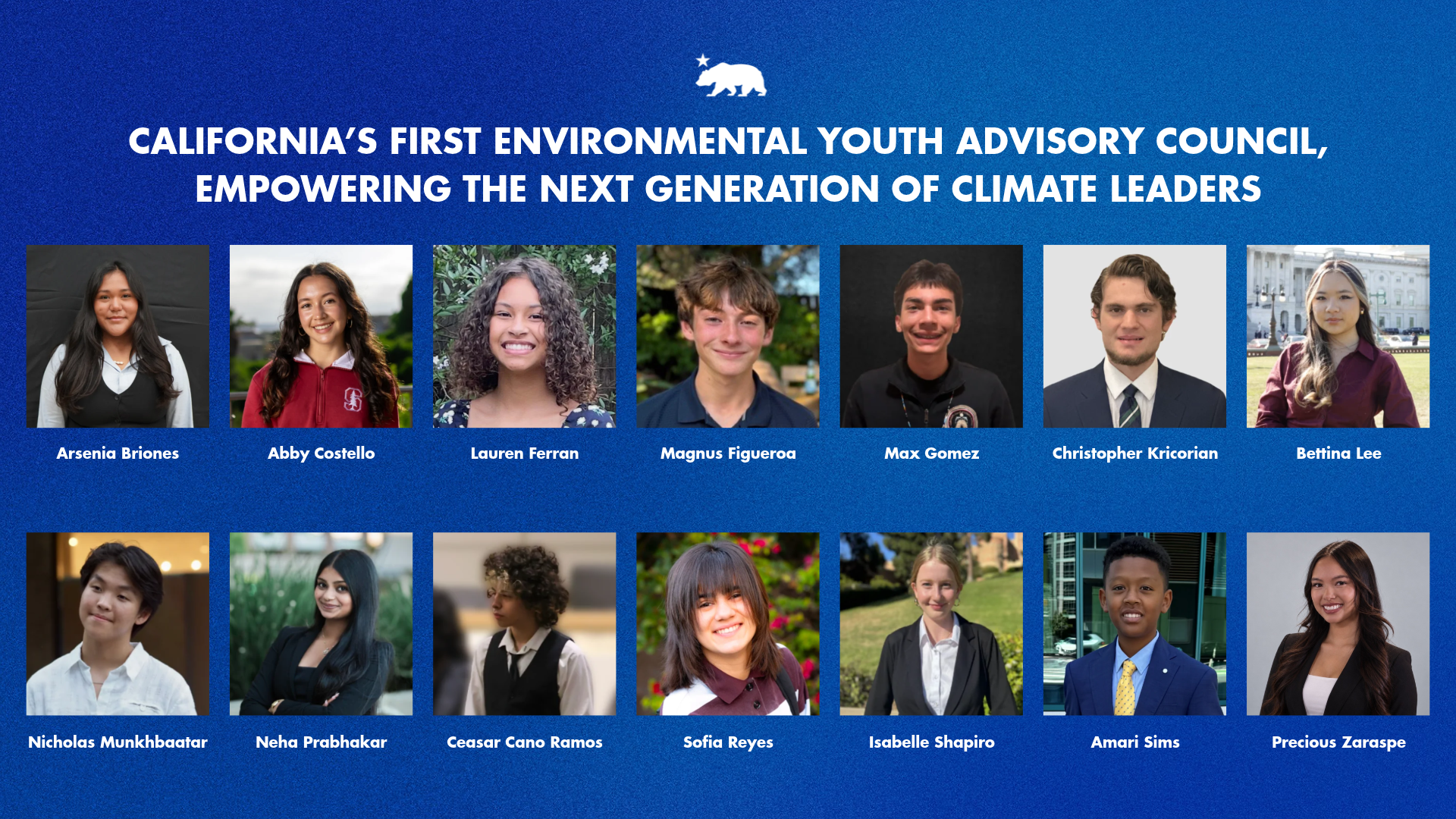
At COP31 in Antalya, Türkiye, on Nov. 12, Governor Gavin Newsom named the first 14 members of California's Environmental Youth Advisory Council. The members are 14 to 20 years old. CalEPA selected them from a pool of more than 300 applicants. The roster spans San Joaquin, San Diego, Alameda, Sonoma, San Bernardino, Ventura, Sacramento, Stanislaus, Fresno, Orange, Los Angeles and Santa Clara counties. [1] [2]
The duties are set out in the governor's release. Members will offer youth perspectives on climate change, air quality, clean water and waste management. They will take up environmental justice, peer outreach, youth priorities and leadership training. The schedule is periodic virtual meetings through the year plus one annual in-person meeting. The first official meeting is in December. CalEPA says the council will strengthen communication and collaboration between young people and the agency, its boards, departments and offices. [1]
The structure is a one-year pilot. The release says the program is scheduled to move to full two-year council terms starting in Fall 2027, with up to 20 members. Members will make recommendations to inform state environmental policies and programs (ID:1). Nothing in the release requires CalEPA to adopt those recommendations. There is no binding role, no recommendation-tracking process, no written response deadline and no named staff assigned to receive the advice. No new appropriation or staffing for the council appears in the announcement. [1]
Those are the administration's stated goals. They are not evidence of influence. [1]
Advertisement
Timing is the tell. Newsom's newsroom promoted California's COP31 participation while saying the Trump administration stayed home and California came to work (source 2). In the same week, the governor's office announced $81 million for climate-smart agriculture projects supporting farmers across 55 counties (source 2), a wildfire exchange with Türkiye (source 2), a meeting with Brazil's President Luiz Inácio Lula da Silva and a partnership with Portugal (source 2). The youth council was one item in an international package built to put the governor on a world stage while Washington sat it out (source 1). [1] [2]
The beneficiaries are visible. Newsom gets a future-oriented COP31 announcement about youth leadership. CalEPA gets a new channel to young people and their communities. The 14 members get training, access to state environmental officials and a role in recommendations (source 1). The release announces no new money or staff for the body (source 1). That makes the council an access point, not an enforcement mechanism. [1]
The agriculture item carried its own numbers. The governor's office said the $81 million would support farmers across 55 counties and that California farm programs have cut 2.6 million metric tons of pollution and saved 1.5 million acre-feet of water since 2014 (source ID 2). In the same newsroom roundup, the governor's office said California brought wildfire expertise to Türkiye and calls its aerial firefighting fleet the world's largest (source ID 2). The youth council release did not include comparable performance metrics. [2]
The California Youth Empowerment Commission comes from AB-46. Its 13 voting commissioners range from 14 to 25 years old. The governor and other state officials appoint them. It advises the Legislature, the superintendent of public instruction and the governor on legislation and fiscal issues affecting young people. It can draft resolutions and model legislation and hold public hearings. Its issue list includes education and career preparation, mental and physical health, housing and homelessness, juvenile justice and foster care, and the climate crisis and civic engagement. [4]
Advertisement
Executive Director Thomisha Wallace describes the commission as an unprecedented chance to help disadvantaged youth through recommendations on policy, legislation and spending. That is the commission's own description of its mission, not an outside evaluation. The commission lists a Nov. 20 Voices for Change forum in Fresno and a Nov. 21 meeting in Sacramento with meeting materials (source ID: 4). [4]
The Teen Tech Council is another model. First Partner Jennifer Siebel Newsom and #HalfTheStory announced its launch in August 2026; the release says it came out of Governor Newsom's California Innovation Council. It convened 20 teens from more than 10 school districts in Sacramento with state leaders. The agenda covered AI safety, deepfake imagery, generative AI in classrooms, AI literacy and human connection. Recruitment was planned for fall 2026 and training for spring 2027. California called itself the second flagship state to adopt the model, after New York. [3]
The claim that the Teen Tech Council is described as a 'technology-policy channel, not a listening session' is not supported by the evidence. The evidence indicates that the Teen Tech Council is designed to include young people in decision-making around technology, which implies a more interactive and consultative role than just a 'listening session'. [3]
The governor's office lists other youth and service programs in the environmental council release: a youth advisory panel attached to the state's women-and-girls commission, the California Conservation Corps and California Service Corps, including its climate, college and youth service branches. The release says those programs provide paid service and career pathways, hands-on training and networks. It places the new council inside a broader youth engagement effort. [1]
Advertisement
The Teen Tech release adds a policy backdrop. Starting in the 2026-27 school year, the Phone-Free School Act requires every district, charter and county office to develop a policy limiting smartphone use. The same release says Newsom signed legislation on age verification, suicide and self-harm protocols, warnings on social platforms and companion bots, and stronger penalties for those who profit from illegal deepfakes. Those measures are separate from the environmental council, but they show the administration's pattern of pairing youth advisory bodies with policy rollouts. [3]
For CalEPA, the release says the council will strengthen communication and collaboration with young people (source 1). Members will see how state policy and programs move from idea to implementation (source 1). They will share community challenges and lead public awareness work (source 1). The release says that work includes fostering civic and environmental engagement among young Californians (source 1). That puts members in front of peers as messengers as well as advisers (source 1). [1]
For the members, the council is hands-on learning. They will work directly with state environmental officials. The first term is one year. The release says the program is scheduled to move to two-year terms in Fall 2027, with up to 20 members. That schedule is a plan, not a guarantee. The sources do not say what triggers the transition. [1]
For the public, the test is transparency. The release names the members and lists their duties. It does not publish a recommendation-tracking process, a response deadline or a rule for disclosing who influences the council's agenda. It also does not disclose the selection criteria, the review panel or the demographic breakdown of the applicant pool. It says the cohort reflects geographic, cultural and socioeconomic diversity and points readers to a CalEPA Youth Council page for mission and future application details. [1]
Advertisement
The entry cannot be corrected based on the provided evidence. The evidence describes the council’s mission, members, and activities, but does not mention whether the release addressed these specific operational questions or not. Therefore, the claim that several operational questions remain unaddressed cannot be verified from the given evidence. [1] [2] [3] [4]
Durability is another open question. The program is scheduled to shift to two-year terms in Fall 2027. Whether a future governor keeps, shrinks or ignores it is not answered by the sources. Neither is whether CalEPA career staff and its boards will treat the council as useful information or a compliance exercise. [1]
Coordination is a gap. The source excerpts do not explicitly state a formal link between the new environmental council and the Teen Tech Council or the Youth Empowerment Commission (source ID 1, 3, 4). It is unclear from the available material whether the bodies will share lessons or operate as separate silos, and whether a fragmented system would duplicate work or dilute influence. [1] [3] [4]
The applicant pool raises a representation question. CalEPA says it chose 14 from more than 300 applicants and that the cohort reflects geographic, cultural and socioeconomic diversity. The release does not give the applicant pool's demographics or the selection rubric. It also does not say whether members serve as individuals or representatives of organizations. Those details would help the public judge how much weight to give the council's advice. [1]
Watch whether those views travel back into the agency. [1]
The Youth Empowerment Commission offers a contrast in disclosure. It lists a Nov. 20 Voices for Change forum in Fresno and a Nov. 21 meeting in Sacramento with meeting materials. The environmental council's announcement does not include an agenda for its December meeting. Meeting materials are the difference between a public body and a press release. [1] [4]
Watch the Fall 2027 transition. The release says the program is scheduled to move to two-year terms and as many as 20 members. If that happens, the council will have a longer runway than the one-year pilot. If it slips, the pilot will remain the operative structure. The release does not explain what triggers the transition. [1]
The entry contains claims not supported by the evidence. The evidence does not mention any absence of new funding or staffing for the council, nor does it reference the need to watch for a staff contact, calendar, or follow-up. The evidence only discusses the announcement of the first 14 members of the Environmental Youth Advisory Council and its mission to engage young people in environmental policy. [1] [2]
Editorial note: This article is sourced. Some claims are awaiting further verification.
Sources
California Governor announcements
Prepared with AI assistance from the cited sources.
The Cali Reporter newsletter
The stories worth your time.
California, the country, and what comes next. Join our free newsletter for reporting that keeps you informed.
More in California
- Elderly Man Robbed in Costco Parking Lot, Four Arrested
A 91-year-old man reported a theft of a ring during an interaction at a Costco in Modesto, leading to the arrest of four individuals.
- Federal Court Halts Closure of East Potomac Park
A federal court has issued a temporary restraining order to prevent the Trump-Vance administration from closing East Potomac Park as part of a plan to convert the area into an exclusive golf course.
- CMS Announces Optional Six-Month Delay for Medicaid Work Requirements
The Centers for Medicare and Medicaid Services (CMS) has announced an optional six-month delay for states implementing Medicaid work requirements, according to a report by KFF.