Newsom Takes California’s Climate Case to COP31
The Antalya pitch is scale, speed and a contrast with Washington. The paper trail is long, the clean-energy numbers are strong, and Newsom says the approach is built into the state’s DNA.
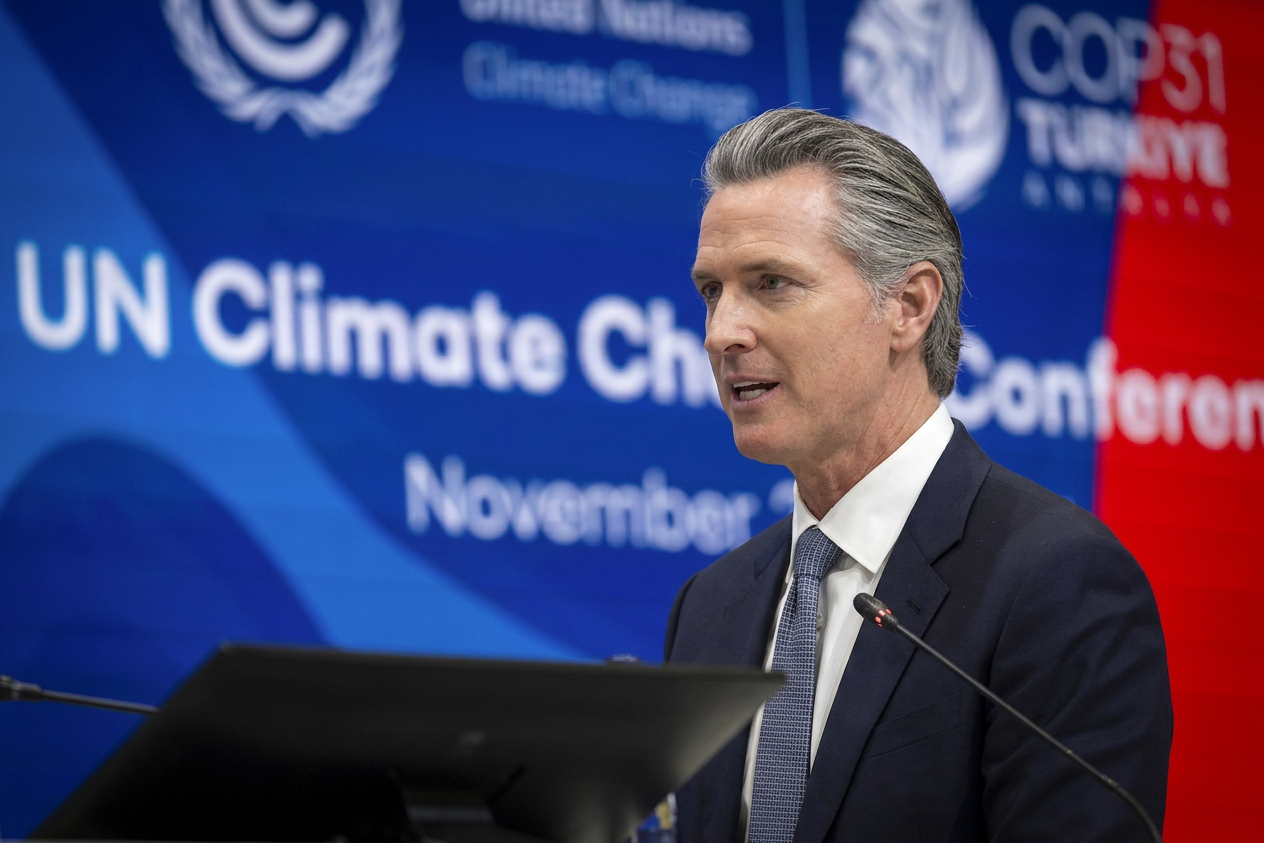
Gov. Gavin Newsom brought California’s climate message to COP31 in Antalya, Türkiye, on Nov. 13. In a press briefing tied to the UN talks, he described the U.S. climate effort as unfinished and said states and regions are not waiting for Washington. He met Australia’s climate minister, Chris Bowen, and stopped at the Ocean Pavilion, which UC San Diego’s Scripps Institution of Oceanography helps lead. [1]
This is the 31st UNFCCC Conference of the Parties. It runs Nov. 9-20, 2026. Türkiye hosts; Australia leads negotiations. The stated theme is implementation: moving pledges into measurable results. California’s delegation included Newsom, First Partner Jennifer Siebel Newsom, Natural Resources Secretary Wade Crowfoot, Food and Agriculture Secretary Karen Ross, CPUC President John Reynolds, CARB Chair Lauren Sanchez and Samuel Assefa, who directs the Governor’s Office of Land Use and Climate Innovation. [1]
The governor’s office also announced $81 million for climate-smart agriculture projects in 55 counties. It says those programs have cut 2.6 million metric tons of pollution and conserved 1.5 million acre-feet of water since 2014. That is an official announcement, not an independent audit. [2]
Newsom’s core claim was scale. He called California the world’s fourth-largest economy. He said that so far this year the state ran for a portion of the day on 100% clean electricity on nine of every 10 days. His line: California is past goal-setting and focused on how, at scale. That is a governing boast from his own release, not a legal commitment. [1]
Advertisement
He pointed at fossil-fuel companies. Newsom said Big Oil is the polluted heart of the crisis and that the same companies earned $100 billion in profit last quarter at consumers’ expense. The release does not supply company-level data for that figure. It is a political assertion by the governor, not an audited accounting. [1]
He dated state regulatory lineage to 1967 and Republican Gov. Ronald Reagan’s creation of CARB. He also said a Republican governor set up cap-and-trade in 2006, when California was the eighth-largest economy, and that big polluters predicted ruin. He said the evidence went the other way. Asked about durability, he cited decades of bipartisan leadership and the expertise of state energy and climate agencies. He said the approach is built into California’s DNA. [1]
He framed California as a stable international partner while calling his federal government a footnote in these conversations. He argued that U.S. climate leadership cannot be reduced to one president. He said California will keep delivering while President Donald Trump does the fossil fuel industry’s bidding. That is the political contrast at the heart of the trip. [1]
Why it matters: California is acting as a subnational diplomat. The governor’s office says the state is a reliable, long-term partner even as Washington retreats. It points to California’s role as a founding member of the Under2 Coalition and U.S. Climate Alliance and co-chair of America Is All In. That is a governing strategy and a political contrast. It also puts credibility on the line at a summit whose theme is delivery. [1]
Advertisement
Who benefits? Clean-energy developers, installers and workers get a favorable spotlight. The release cites 552,300 clean-energy jobs. Agricultural projects get the $81 million. Australia’s government got specific technical exchange, according to the release: CARB input on vehicle standards and CPUC and California ISO advice on electricity markets. Newsom gets a world stage and a contrast with Trump. The release is a diplomatic readout and a political document at once. [1] [2]
The Australia file shows paper turning into practice. California and Australia signed a five-year climate MOU in 2023. It covered clean power, cleaner transportation, clean technology, natural systems, adaptation, green finance and circular economy. Newsom and Ambassador Kevin Rudd led the signing at the Stanford Mansion in Sacramento. The governor’s office says CARB input fed into Australia’s debut vehicle carbon standards. It says CPUC and California ISO advised Australia on electricity-market reform. Research exchanges have touched critical minerals, grid innovation and energy storage. [1] [3]
Africa is the next front. California signed a partnership with Kenya in 2025 to cut pollution and support trade. The Nigeria MOU spans cleaner transport, greener ports, lower-carbon fuels, methane cuts, adaptation, air quality and academic cooperation. A Brazil MOU followed in September 2025. At COP31, Crowfoot attended an Under2 Coalition breakfast with African state and regional officials. The stated aim was to build investment, trade and innovation ahead of COP32 in Addis Ababa. [1] [4]
The partnership inventory is long. Portugal and the United Kingdom signed 2026 MOUs. Chile and Colombia signed in 2025. Brazil’s Pará state cooperates on wildfire. Noord-Holland works on next-generation air mobility. British Columbia exchanges wildfire personnel. China signed five MOUs in 2023. Denmark has a 2021 water agreement. Mexico’s Baja California and Sonora work on zero-emission freight and clean ports. The Newsom administration says it has formed more than 70 international partnerships. [1]
Advertisement
Read the fine print. The release calls these MOUs and partnerships. It does not describe them as new statutes or treaty text. It also does not quantify emissions results from the partnerships themselves. In plain Sacramento terms, the governor can sign cooperation documents and announce programs. The release does not show legislative votes or new binding targets. That is the gap between diplomacy and enforceable policy. [1]
The international strategy predates COP31. In 2022, California signed memorandums with Canada, New Zealand and Japan, plus MOUs with China and the Netherlands. It joined Washington, Oregon and British Columbia in a regional climate recommitment. In 2023, Newsom signed five China MOUs and a separate Hainan agreement. The governor’s office says its partners span 28 countries, represent over a quarter of global population and account for tens of trillions in combined GDP. [3] [4]
The Australia MOU has a concrete policy trace. Signed for five years in 2023, it was led by Newsom and Rudd. It lists clean energy, clean transportation, clean technologies, nature-based solutions, adaptation, green finance and circular economy. The governor’s office now says CARB input fed Australia’s first vehicle carbon standards, and CPUC and California ISO advised on electricity-market reform. That is the sort of paper-to-practice claim COP31’s implementation theme demands. It is still the state’s account, not an independent evaluation. [1] [3]
The domestic stats are the strongest part of the case. Since Newsom took office, the state grid has gained over 39,000 megawatts of utility-scale clean power, per his office. At the end of 2024, 67% of retail electricity sales came from clean energy. On 279 days last year, clean power covered all state electricity demand for some portion of the day. Battery capacity climbed past 23,000 megawatts, up more than 3,100% from under 700 megawatts in 2019. [1]
Advertisement
Jobs are the political counterweight to cost worries. The release cites a 2025 E2 report putting California at 552,300 clean-energy workers, nearly twice second-ranked Texas. The clean-energy workforce added almost 7,300 jobs in 2024, more than triple the growth rate of the rest of the state economy, per the release. Those are the governor’s chosen numbers. They are not independent audits in this release. [1]
The agriculture announcement adds a second metric set. The governor’s office says $81 million will help farmers save water, improve soil health and cut pollution across 55 counties. It also says state farm programs have reduced 2.6 million metric tons of pollution and conserved 1.5 million acre-feet of water since 2014. Those are official claims tied to state programs, not a full cost-benefit analysis. [2]
The clean-energy numbers are the state’s best answer to the cost question. The release says batteries store solar and reduce how often the state runs natural gas plants. That cuts pollution and supports a more cost-effective grid, in the governor’s account. It also says global investors now put about $2 in clean-energy technology for each $1 in fossil fuels. That is where the governor says money and jobs are heading. [1]
But the release does not show the fiscal trade-offs. The $81 million is an announcement, not a permanent appropriation in this document. The clean-energy statistics describe progress, not future budgets. The governor’s office is asking international partners and California voters to trust the trajectory. The release does not show who pays for the next round. [1] [2]
Question one: what happens after Newsom? He was asked whether commitments will last beyond his administration. He pointed to decades of bipartisan leadership and the expertise of state energy and climate agencies. He said the approach is built into California’s DNA. The release does not cite a new legal mechanism in that answer. It offers a cultural and institutional case. [1]
Question two: what do the MOUs deliver? The release lists meetings, signatories and subject areas. It does not list quantified outcomes for the partnerships. COP31’s stated focus is implementation, so the burden is on the state to show measurable results, not just a busy calendar. The Australia example includes specific policy influence in the release. [1]
Question three: what does federal absence cost or save California? Newsom says the federal government is a footnote and argues that U.S. climate leadership cannot be reduced to one president. But the release does not analyze how federal policy, funding or diplomacy affects state programs. It uses Washington as a foil. That is politics, not a full risk assessment. [1]
Watch the COP31 closing stretch through Nov. 20. Australia leads negotiations. The conference theme is implementation. The test is whether the final package contains concrete, measurable results, not just applause lines. Newsom’s Antalya speech will be judged against that standard, not against the press release. [1]
Watch COP32 in Addis Ababa. Crowfoot’s Under2 breakfast with Moroccan, Nigerian, South African, Senegalese and Kenyan leaders was framed as the road to next year’s summit. If California’s Africa partnerships produce deals, pilots or trade, that is concrete follow-through. If they remain communiqués, skeptics will have a point. [1]
Watch the data and the money. The clean-energy numbers, battery growth and job figures will be updated. The $81 million agriculture program will need implementation. The Australia vehicle-standards and electricity-market story will need verification over time. Those are the measurable tests. The political contrast with Washington is already clear. The governing record is still being written. [1] [2]
Sources
California Governor announcements
Prepared with AI assistance from the cited sources.
The Cali Reporter newsletter
The stories worth your time.
California, the country, and what comes next. Join our free newsletter for reporting that keeps you informed.
More in California
- Elderly Man Robbed in Costco Parking Lot, Four Arrested
A 91-year-old man reported a theft of a ring during an interaction at a Costco in Modesto, leading to the arrest of four individuals.
- Federal Court Halts Closure of East Potomac Park
A federal court has issued a temporary restraining order to prevent the Trump-Vance administration from closing East Potomac Park as part of a plan to convert the area into an exclusive golf course.
- CMS Announces Optional Six-Month Delay for Medicaid Work Requirements
The Centers for Medicare and Medicaid Services (CMS) has announced an optional six-month delay for states implementing Medicaid work requirements, according to a report by KFF.