New Study Suggests Uranus and Neptune's Magnetic Fields May Change Dramatically
A new study suggests that the magnetic fields of Uranus and Neptune may be far less stable than previously thought, with their magnetic axes potentially shifting by tens of degrees within decades.

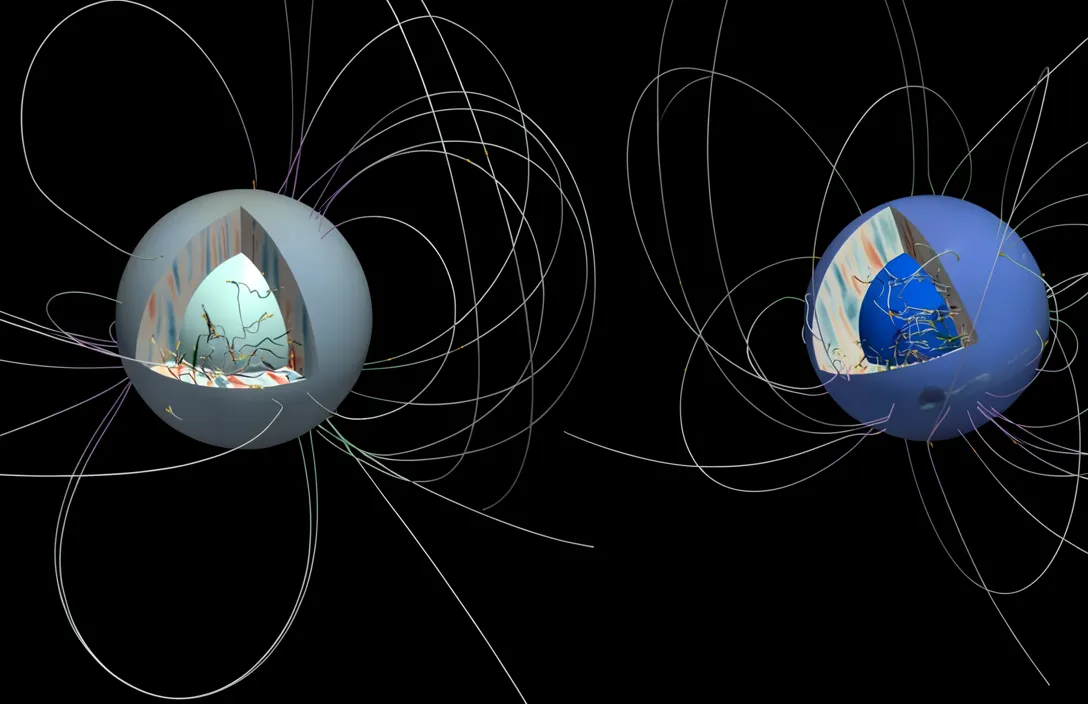
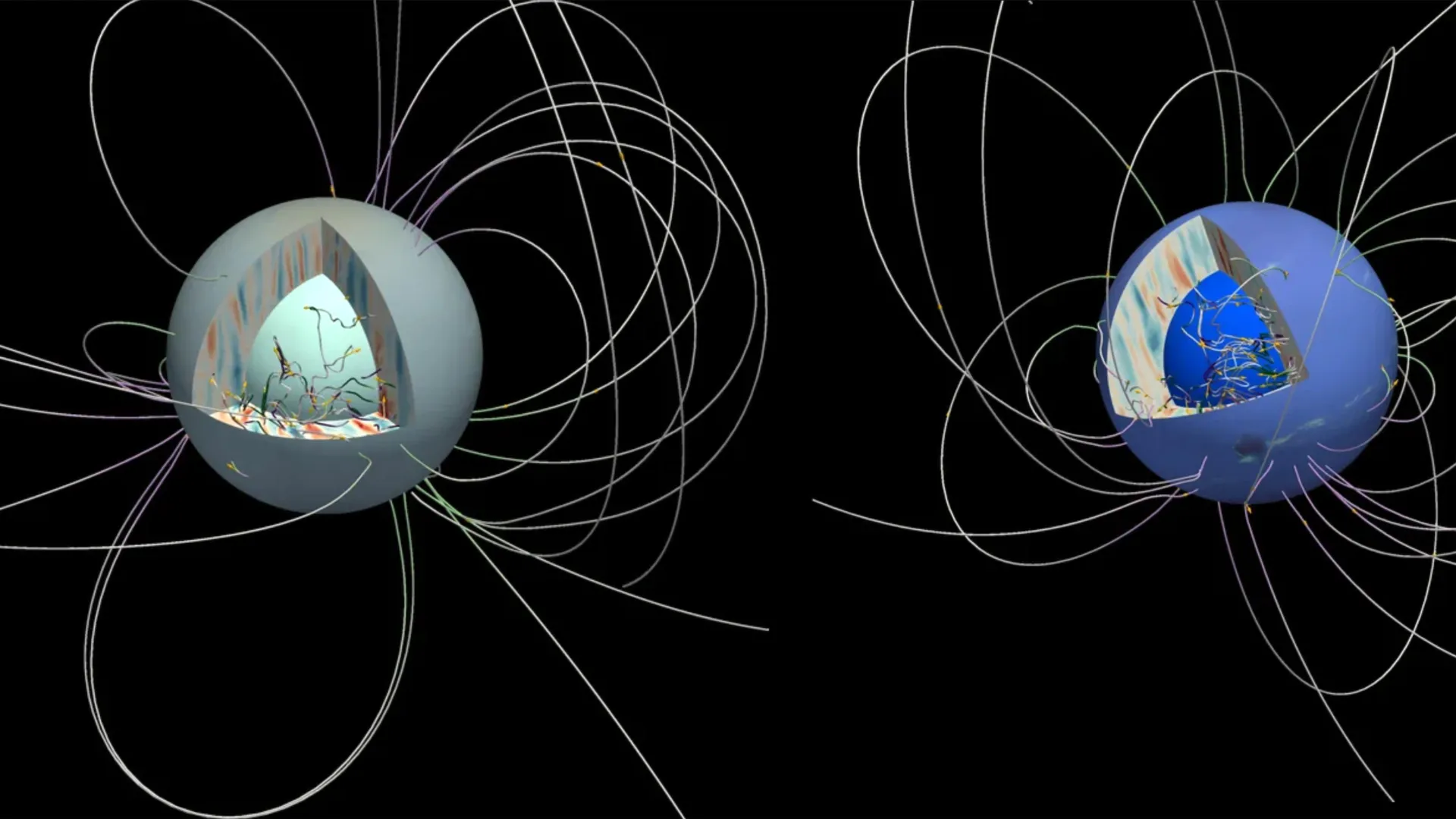
When NASA's Voyager 2 spacecraft visited Uranus and Neptune in the 1980s, it discovered that both planets have strangely distorted and dramatically tilted magnetic fields, unlike Earth's relatively orderly magnetic field (1). Scientists have long struggled to explain this phenomenon, but a new study suggests that changes in how well materials conduct electricity under extreme conditions could be the key (1). The research, published in Communications Physics, was led by scientists at The University of Texas at Austin in collaboration with researchers from several other institutions (1). [1]
Planetary magnetic fields originate deep beneath the surface, where moving fluids capable of conducting electricity generate magnetic forces through a process known as a dynamo (1). On Earth, the dynamo operates within the outer core, but Uranus and Neptune are classified as ice giants, with interiors that likely contain substantial amounts of hydrogen, helium, water, ammonia, methane, and rocky material (1). However, their precise internal compositions remain uncertain (1). [1]
Chi Yan, the study's lead author, believes the combination of the planets' enormous size and unusual chemical makeup may help explain their distorted magnetic fields (1). The researchers developed computer simulations to reproduce the strange magnetic fields recorded by Voyager 2, assuming that electrical conductivity increases deeper inside the planets (1). The results suggest that these changing electrical properties could play a crucial role in producing the unusual magnetic fields observed around both ice giants (1). [1]
According to the simulations, the magnetic axes of Uranus and Neptune could undergo substantial changes in relatively short periods, with some scenarios showing shifts of tens of degrees within only a few decades (1). Researchers are now examining detailed infrared images of Uranus and Neptune captured by the James Webb Space Telescope (JWST), particularly interested in the planets' auroras, which could provide clues about magnetic changes (1). [1]
Advertisement
When NASA's Voyager 2 spacecraft visited Uranus and Neptune in the 1980s, it discovered that both planets have strangely distorted and dramatically tilted magnetic fields, unlike Earth's relatively orderly magnetic field (1). Planetary magnetic fields originate deep beneath the surface, where moving fluids capable of conducting electricity generate magnetic forces through a process known as a dynamo (1). Chi Yan, the study's lead author, believes the combination of the planets' enormous size and unusual chemical makeup may help explain their distorted magnetic fields (1). [1]
According to the simulations, the magnetic axes of Uranus and Neptune could undergo substantial changes in relatively short periods. In some scenarios, the magnetic tilt shifted by tens of degrees within only a few decades (1). This raises the possibility that the magnetic fields surrounding Uranus and Neptune today are significantly different from those measured when Voyager 2 flew past them in the 1980s (1). [1]
Researchers are now examining detailed infrared images of Uranus and Neptune captured by the James Webb Space Telescope (JWST). They are particularly interested in the planets' auroras, which form when charged particles from the Sun interact with gases in their atmospheres (1). Changes in the appearance and arrangement of these glowing atmospheric features could help researchers determine whether the magnetic poles have shifted since Voyager 2's encounters (1). [1]
According to simulations, the magnetic axes of Uranus and Neptune could undergo substantial changes in relatively short periods (1). This finding challenges previous assumptions about the stability of planetary magnetic fields, which are typically thought to remain relatively constant over long timescales. Chi Yan, the study's lead author, believes that the combination of the planets' enormous size and unusual chemical makeup may help explain their distorted magnetic fields (1). The simulations suggest that the magnetic tilt of these ice giants may shift dramatically within decades, a phenomenon that is not observed on Earth (1). [1]
Advertisement
The research team developed computer simulations designed to reproduce the strange magnetic fields recorded by Voyager 2, assuming that electrical conductivity increases deeper inside the planets (1). These models suggest that changing electrical properties could play a crucial role in producing the unusual magnetic fields observed around both ice giants (1). The findings raise the possibility that the magnetic fields surrounding Uranus and Neptune today are significantly different from those measured when Voyager 2 flew past them in the 1980s (1). [1]
Researchers are now examining detailed infrared images of Uranus and Neptune captured by the James Webb Space Telescope (JWST) to look for evidence of magnetic changes (1). They are particularly interested in the planets' auroras, which are closely connected to planetary magnetic fields and could provide valuable clues about shifts in the magnetic poles (1). Changes in the appearance and arrangement of these glowing atmospheric features could help determine whether the magnetic poles have shifted since Voyager 2's encounters (1). [1]
Researchers are now examining detailed infrared images of Uranus and Neptune captured by the James Webb Space Telescope (JWST) to look for evidence of magnetic changes (1). These images are being analyzed for clues about the planets' auroras, which are shaped by their magnetic fields. Auroras form when charged particles from the Sun interact with the atmospheres of planets, and their appearance can indicate the orientation and strength of magnetic fields (1). Scientists believe that changes in the auroras' structure could signal shifts in the magnetic axes of Uranus and Neptune, potentially confirming predictions from computer simulations (1). [1]
The ionosphere, a region of the upper atmosphere containing electrically charged particles, is another area of focus for researchers (1). The behavior of the ionosphere is influenced by magnetic activity, and changes in its structure may provide additional evidence of magnetic field shifts (1). Tom Stallard, a professor at Northumbria University who led the JWST observation campaign, noted that the shape and structure of the aurora, as well as other patterns in the ionosphere, could help scientists determine whether the magnetic poles have shifted since Voyager 2's encounters (1). [1]
Advertisement
The research team hopes to combine JWST's auroral observations with Voyager 2's original magnetic field measurements and the new dynamo simulations to create the clearest picture yet of how the magnetic fields of Uranus and Neptune are arranged today (1). However, scientists emphasize that fully understanding the planets' deep interiors will require new spacecraft missions to these distant worlds (1). Until then, improved simulations and powerful telescopes may help unravel one of the solar system's most unusual magnetic mysteries (1). [1]
Sources
Prepared with AI assistance from the cited sources.
The Cali Reporter newsletter
The stories worth your time.
California, the country, and what comes next. Join our free newsletter for reporting that keeps you informed.
More in Science
- Erect-Crested Penguin Populations Show Contrasting Trends
A new study reveals that the Erect-crested penguin populations on the Bounty and Antipodes islands are experiencing dramatically different outcomes, with one stable and the other declining sharply.
- Dinosaurs May Have Eaten Seaweed Based on Fossil Evidence
New research suggests that marine resources, such as seaweed, may have supplemented the diets of dinosaurs and other prehistoric animals along ancient coastlines, according to a study published in Frontiers in Ecology…
- New Study Suggests Earth May Have Generated Its Own Water
A recent study published in Nature Geoscience proposes that Earth may have created a significant portion of its water through chemical reactions during its formation, rather than relying solely on external sources like…