Preservation of Classic Game Screens Through Emulation
A fan-made website provides a detailed look at the preservation of classic game screens through various emulators and scaling techniques.

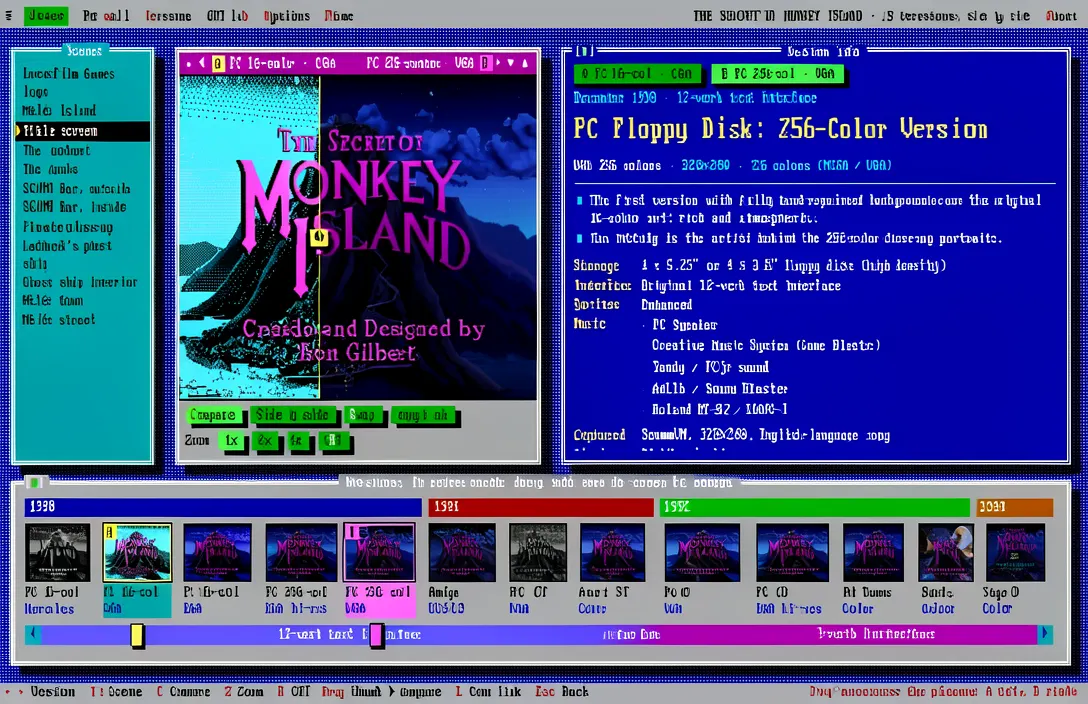
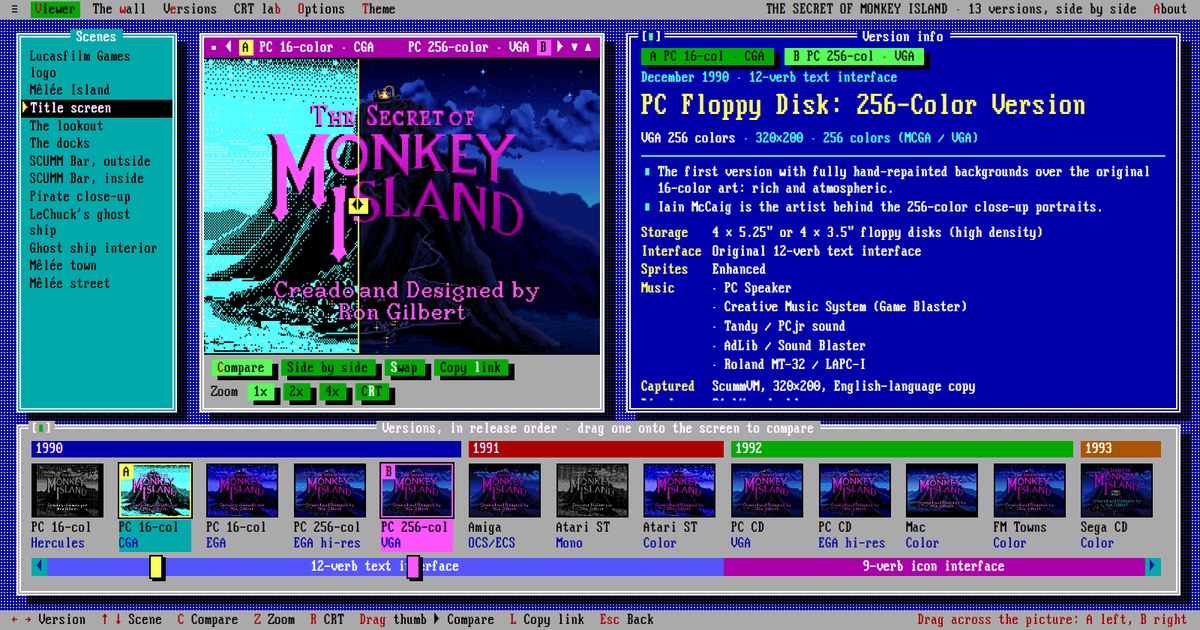
The screen captures displayed on the HN (Official) website were generated using ScummVM, with the exception of Atari ST monochrome screens, which were captured using the Hatari emulator (source ID 1). Each screen was scaled to 1600x1200 pixels using nearest-neighbour scaling and 4:3 aspect correction to preserve the original pixel shape as it would have appeared on period monitors. This method ensures that every original pixel retains its form, maintaining the visual fidelity of the original games. [1]
The twelve moments displayed in each version of the screen captures are consistent across all versions, with the same framing and positioning. Differences between versions are attributed to the machine used for rendering, rather than the moment itself (source ID 1). The PC 16-color screens originate from a Spanish copy, while the Atari ST mono screens come from a French copy; all other versions are in English. These differences reflect the regional variations in game releases during the time period. [1]
The capture settings used for these screen captures emphasize technical accuracy, with emulators such as ScummVM and Hatari being utilized to ensure that each version is drawn from its native pixels on the monitor closest to its original hardware (source ID 1). The settings include 1600x1200 pixels per screen, nearest-neighbour scaling, and 4:3 aspect correction, ensuring that the visual representation aligns with the original hardware specifications. [1]
The website https://monkeyisland.pages.dev/ features screenshots of *The Secret of Monkey Island* captured using ScummVM and Hatari emulator for Atari ST monochrome screens. All screenshots are scaled uniformly to 1600x1200 pixels with nearest-neighbour scaling and 4:3 aspect correction to preserve the original pixel shape as displayed on period monitors. The content includes twelve consistent moments across all versions, ensuring that the framing remains the same while only the machine-specific rendering differs. The PC 16-color screenshots originate from a Spanish copy, and Atari ST mono screenshots come from a French copy, while the rest are in English. [1]
Advertisement
The site documents the technical settings used for captures, including emulator sources such as ScummVM and Hatari, and output specifications like 1600x1200 pixels per screen with nearest-neighbour scaling and 4:3 aspect correction. It mentions that the Mac version displays a 640x400 image within a 640x480 screen, adding black bars, while the Hercules display uses the middle 640 columns of its 720-column resolution. The CRT shader used is from DOSBox Staging, ported to WebGL2, and it includes presets from Hyllian's CRT shader and its own VGA shaders for low-resolution screens. [1]
The site also provides details on the hardware emulation specifics, such as the PC and FM Towns using a 31 kHz VGA monitor with 200 lines drawn twice for 400 fine scanlines, and the Mac using a similar monitor at 480 lines. EGA and CGA versions use a 31/15 kHz button to switch between VGA and card-specific 15.7 kHz monitors. Amiga, ST, and Sega CD versions use a 15 kHz monitor or TV with DOSBox's arcade presets, creating dark gaps between scanlines. Hercules and ST mono versions have no mask, with Hercules displayed in white, green, or amber phosphor. [1]
The project is a fan-made reference created by The Paninos, a team of two brothers, and is not affiliated with Lucasfilm Games, LucasArts, or Disney. It also mentions a separate project to remake *The Black Cauldron (1986)* using Adventure Game Studio, which is free and non-commercial. The site includes licensing information for the CRT shader and other components, with credits to developers such as Hyllian, guest(r), Dr. Venom, and The DOSBox Staging Team under MIT and GNU GPL v2 or later licenses. [1]
The screen captures displayed on the HN (Official) website were generated using ScummVM, with the exception of Atari ST monochrome screens, which were captured using the Hatari emulator (source ID 1). This approach ensures that each version of the screen captures is drawn from its native pixels on the monitor closest to its original hardware. [1]
Advertisement
Each capture was scaled to 1600x1200 with nearest-neighbour pixels and 4:3 aspect correction, so every original pixel keeps the shape it had on a period monitor (source ID 1). This scaling method preserves the visual integrity of the original screens as they would have appeared on their respective hardware. [1]
The twelve moments displayed in each version of the screen captures are consistent across all versions, with the same framing and positioning (source ID 1). This consistency allows for direct comparison between different versions of the game, focusing on the differences in hardware and software rather than the content itself. [1]
The screen captures displayed on the HN (Official) website were generated using ScummVM, with the exception of Atari ST monochrome screens, which were captured using the Hatari emulator (source ID 1). This approach ensures that each version of the screen captures is drawn from its native pixels on the monitor closest to its original hardware, maintaining a high level of technical accuracy. [1]
Each capture was scaled to 1600x1200 with nearest-neighbour pixels and 4:3 aspect correction, so every original pixel keeps the shape it had on a period monitor (source ID 1). This scaling method is designed to preserve the visual fidelity of the original screens as they would have appeared on the hardware of the time. [1]
Advertisement
The twelve moments displayed in each version of the screen captures are consistent across all versions, with the same framing and positioning (source ID 1). This consistency ensures that users can compare different versions of the screen captures without any changes in the content or layout of the scenes themselves. [1]
Sources
Prepared with AI assistance from the cited sources.
The Cali Reporter newsletter
The stories worth your time.
California, the country, and what comes next. Join our free newsletter for reporting that keeps you informed.
More in Technology
- Google Play's Closed Testing Requirements and the Importance of Feedback
Google Play's closed testing rule emphasizes the need for developers to gather meaningful feedback from testers, not just track app installs. This approach ensures that real user experiences are evaluated and addressed…
- World Diabetes Day 2026 Focuses on Early Diagnosis and Awareness
The 2026 World Diabetes Day campaign emphasizes the importance of early diagnosis, equitable access to care, and reducing diabetes stigma, according to the WHO. The theme 'Early action on diabetes' highlights the need…
- Understanding Memory Usage on Linux VPS
This article explains how to accurately interpret memory usage on a Linux VPS, focusing on the importance of the 'available' metric and the potential pitfalls of relying on the 'free' column.